

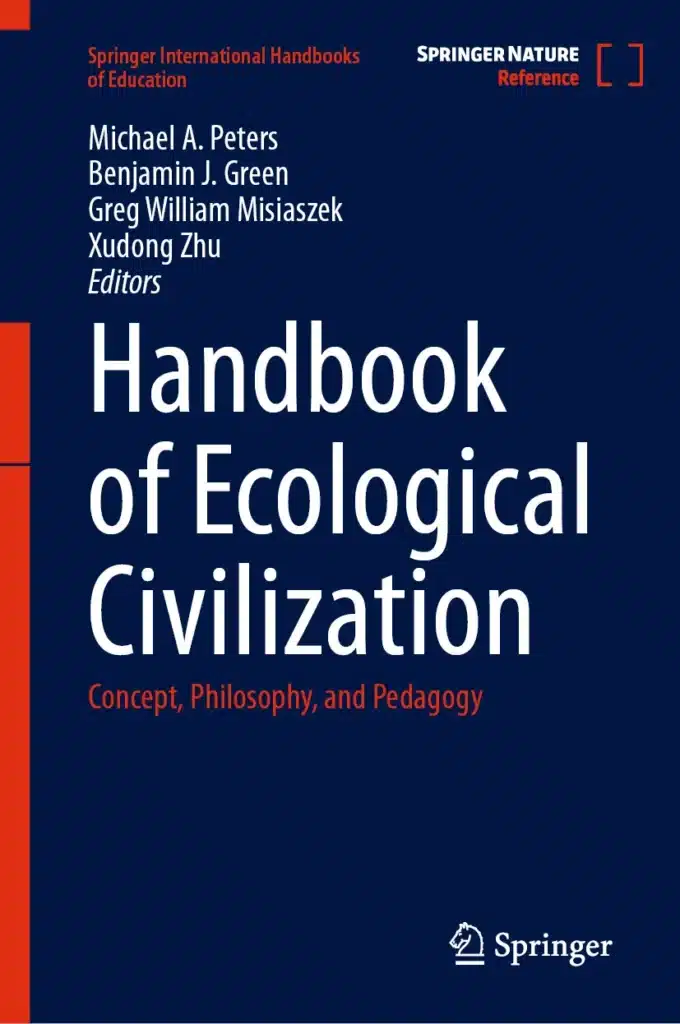
A newly released volume, Handbook of Ecological Civilization: Concept, Philosophy, and Pedagogy, brings together leading international scholars to examine one of the most urgent intellectual and practical challenges of our time. Edited by Michael A. Peters, Benjamin J. Green, Greg William Misiaszek, and Xudong Zhu, the book offers a comprehensive exploration of the concept of Ecological Civilization and its implications for education, policy, and global development.
Published by Springer, the handbook features 79 chapters organized into five main sections: Dedication and Foreword; Philosophical, Technological, and Scientific Foundations; Transformative Educational Approaches and Applications; Practical Applications and Global Perspectives; and Theory, Policy, and Educational Practice. The volume also includes a dedicated section on ecopedagogies and concludes with an afterword.
The Handbook of Ecological Civilization is a timely publication as it offers a rich variety of insightful ideas, examples, and recommendations on what we could consider the most urgent and important legacy our generation should leave behind: put humanity on the path of an Ecological Civilization.
-Mirian Vilela, Earth Charter International
The collection traces the historical and philosophical evolution of Ecological Civilization while examining its contemporary relevance as a transdisciplinary framework that can shape teaching, research, and societal transformation. Several chapters draw on ancient Chinese aesthetics and spirituality, emphasizing harmony between humanity and nature as a defining principle of civilization.
A central section of the book, Transformative Educational Approaches and Applications, focuses on pedagogical frameworks that support the transition toward an Ecological Civilization. It highlights innovative approaches such as ecopedagogy, place-based learning, and curriculum integration, supported by case studies from China and other regions.
It is important to highlight that several contributions to this publication are also contributions to Earth Charter scholarly work exploring connections between Ecological Civilization and the Earth Charter, namely:
- The Foreword, by Mirian Vilela, Executive Director of the Earth Charter International Secretariat.
- “Reimagining Higher Education for an Ecological Civilization,” by Alejandro Álvarez-Vanegas (Colombia)
- “The Earth Charter as a Pedagogical Opportunity to Imagine a Biocivilization,” by Nicole Jirón Beirute (Costa Rica)
- “New Ways of Living and Being in the World: Education’s Role in Creating an Ecological Civilization,” by Waverli Maia Matarazzo-Neuberger (Brazil)
- “Cultivating Wisdom for an Ecological Civilization,” by Mark D. Hathaway (Canada)
- “Fostering Children’s Embodied Wisdom as Education for Ecological Civilizations,” by K. Malone and P. Corcoran
- “The Earth Stories Collection: Building an Ecological Civilization through Selected Myths, Legends and Folktales,” by Grian Cutanda (Spain)
- “Earth Charter: A Beacon for African Youth for a Sustainable Planet,” by Kamugisha Marsiale (Uganda)
- “The Earth Charter and the Integral Foundations of Ecological Civilization,” by Bjørn Heyerdahl (South Africa)
- “Educators’ Perspectives on Integrating Values-Based Education for Democracy, Nonviolence, and Peace to Enhance Education for Sustainable Development,” by Olivia Opere and Mary Otieno (Kenya)
The volume also features the valuable chapter “Ecological Civilization and Confucian Values” by Mary Evelyn Tucker, further enriching the dialogue between cultural traditions and sustainability frameworks.
Overall, the handbook represents a significant contribution to ongoing global efforts to advance an Ecological Civilization, offering both theoretical insights and practical pathways for educators, researchers, and policymakers.