

With 14 students, three teachers, and an ecological park that keeps growing into every corner, this small public school in Desamparados, Costa Rica, renews its certification and sets a milestone for the global Earth Charter network.
La Joya School has become the first school in the world to complete the Earth Charter School Sustainability Seal (ECSS) process twice. It earned its first certification in 2022 and began the journey again in 2026, this time with a sharper eye on its own practice.
Founded in 1948, an hour south of San José, La Joya is a small rural school with a large conviction: the surroundings teach too. Its mission is to open learning spaces where students build skills for life, in collaboration and in care for the Earth.
An ecological park that works as a classroom
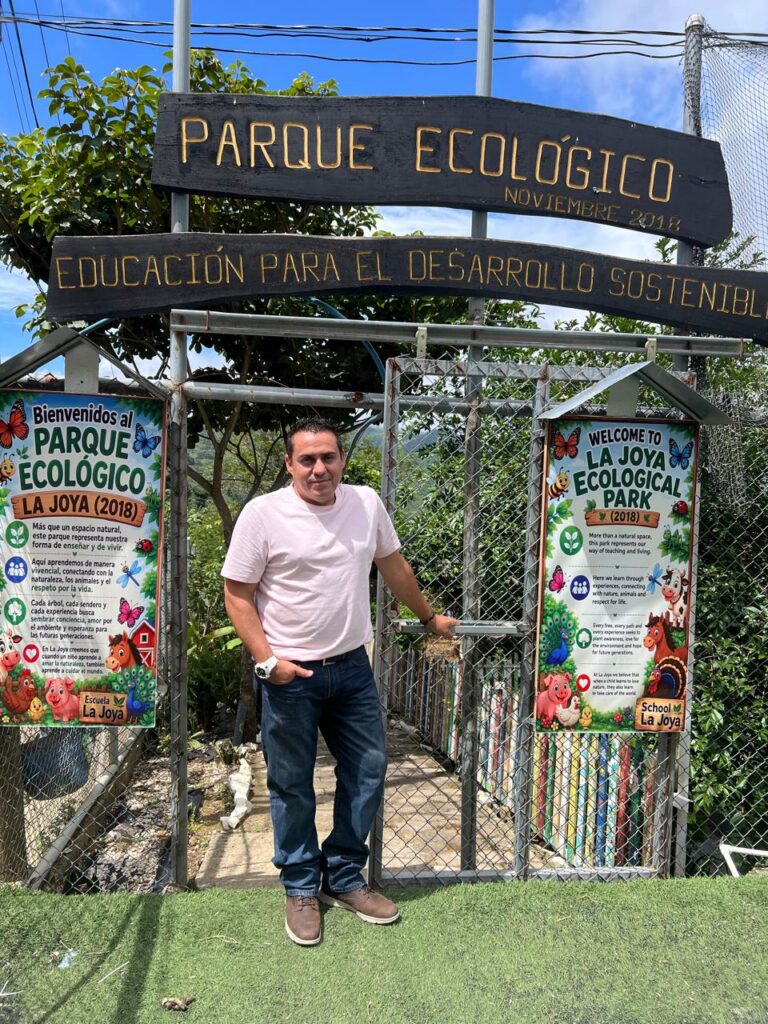
When school director, Banacheck García, arrived, 15 years ago, he found high dropout rates and few pathways for students to continue into secondary education. With community support and limited resources, the school chose to expand outward. In 2018 it opened its Ecological Park, today a mosaic of living spaces: a school farm, school garden, ecological classroom, community garden, outdoor library, educational greenhouse, natural pharmacy, path of values, composting station, botanical garden, and math literacy garden.
Every programme connects to at least one of the four pillars of the Earth Charter. The composting project, monitored by students, produces low-cost organic fertilizer that feeds the other initiatives. More than 150 recycled tires now hold a steep hillside in place, prevent erosion, and serve as planting beds in the “Llantas que Alimentan” project. Vegetables and herbs from the garden reach the school kitchen, and the surplus travels home with students, along with seeds so families can grow their own.
Assessing again, and going deeper
The first assessment taught the school to read its own curriculum through the Earth Charter. The second took it further: it asked staff to examine the purpose behind each programme and to design interdisciplinary education for sustainable development with intention.
That exercise left a daily mark. Sustainability stopped being a topic and became a way of deciding. By learning through the care of animals and plants, students practise an empathy that begins with nature and their classmates, then reaches their neighbours and the wider world.
The community as the root
Families, volunteers, and partner organizations sustain the Ecological Park through plant sales, volunteer days, and community garden plots along its fence. The Footprints that Inspire project dedicates spaces to those who helped build it. The Ministry of Agriculture and Livestock, the 4S Clubs Programme, and the University of Costa Rica contribute technical expertise and learning opportunities.
The school’s record also includes the Ministry of Education’s Blue Flag Programme with five stars, certification as a Carbon Neutral Educational Center by the Green Trust Foundation, the REDUCA Award 2021-2022, the Cardenillo Award, and recognition from the Municipality of Desamparados for its environmental outreach.
What comes next
La Joya is now building partnerships to install solar panels that would light the Ecological Park at night and keep it open and safe for the community. Two additional 1,000-litre tanks are planned to expand rainwater harvesting for the dry season, and the school intends to deepen its composting and recycling work.
School profile documented by Carly Jo Riggins.