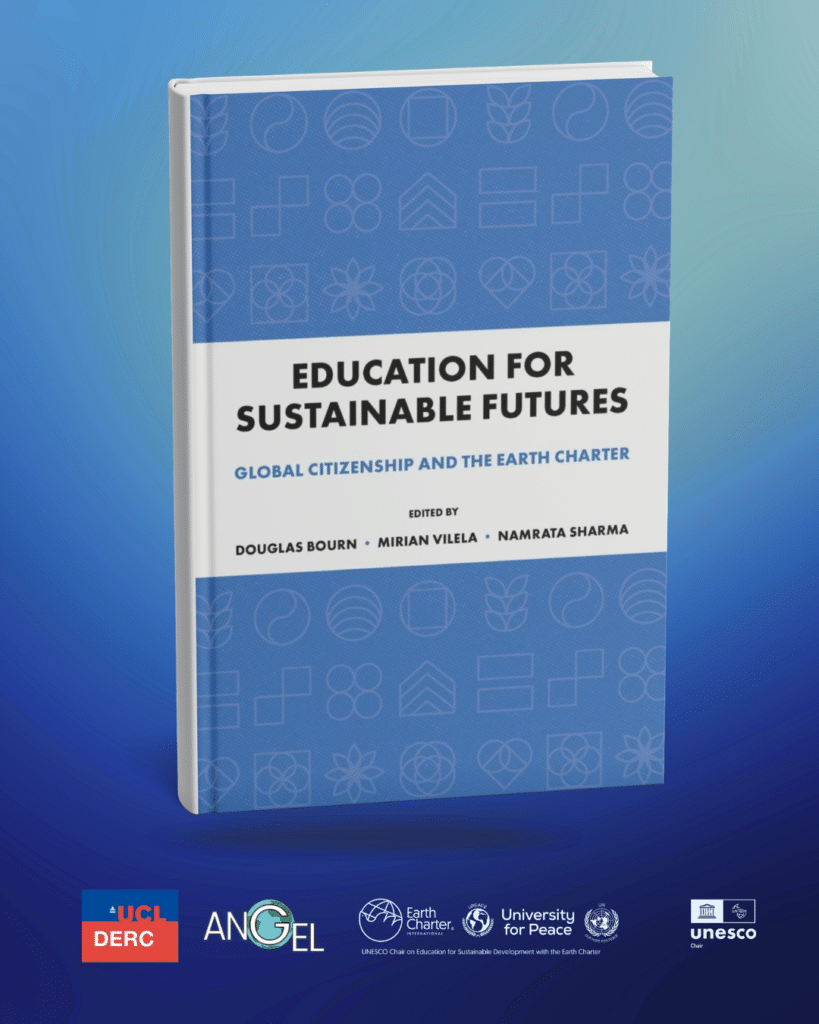


A year ago, we celebrated the publication of Education for Sustainable Futures: Global Citizenship and the Earth Charter, edited by Douglas Bourn, Namrata Sharma, and Mirian Vilela, and published by Emerald Publishing.
One year later, we revisited this important collection and were reminded of its continued relevance for educators, researchers, policymakers, and all those interested in the role of education and particularly values-based education, in creating more sustainable futures.
The book explores the role of education in shaping sustainable futures through the lens of the Earth Charter. It brings together practical examples, research findings, and theoretical debates that illustrate how the Earth Charter has informed educational practices and policy initiatives in diverse contexts around the world.
The contemporary movement in support of education of the whole person includes the holistic education movement, character education, social and emotional learning, and the promotion of mindfulness-based meditation practices designed to reduce stress and nurture kindness and compassion.
Steven C. Rockefeller – Earth Charter Commissioner and chair of the drafting committee.
More than presenting examples of how the Earth Charter has been applied in education, and also some critical reflections, the volume offers a broader reflection on the contribution of the Charter to Education for Sustainable Futures, Global Citizenship Education, and other educational efforts aimed at social and ecological transformation.
The collection brings together 22 chapters and a foreword, with contributions from 32 authors from all regions of the world. Their diverse perspectives provide a rich picture of how education can engage with the complex challenges facing our societies and contribute to building more sustainable and just futures.
The book is organized into five parts:
- Theoretical Debates – exploring concepts and ideas that underpin education for sustainable futures and global citizenship.
- Intersectionality – examining the connections between different dimensions of social and ecological challenges.
- Value-Creating Education – focusing on the role of values and ethical perspectives in educational transformation.
- Evidence from Research – presenting research and experiences that demonstrate the relevance and impact of these approaches.
- From Policy to Practice – exploring how ideas and commitments can be translated into educational policies and practices.
Together, these contributions demonstrate the richness of the Earth Charter as an ethical framework for education and invite us to consider how education can go beyond transmitting knowledge to help cultivate values, relationships, responsibilities, and capacities for creating a sustainable future.
The role and importance of education has never been greater to enable people of all ages to be able to look at issues critically from a range of perspectives, enhance their willingness and capacity to engage in processes of social change and contribute to the common good, and the building of a more just and sustainable future.
Douglas Bourn, Mirian Vilela and Namrata Sharma
At a time when educators and institutions are seeking meaningful ways to respond to interconnected global challenges, this collection offers ideas, experiences, and perspectives that remain highly relevant.
Education is not simply about preparing people for the future. It is also about helping shape the future we want.
We invite educators, researchers, students, policymakers, and others interested in transformative education to rediscover Education for Sustainable Futures: Global Citizenship and the Earth Charter and explore the many ways in which the Earth Charter can contribute to education for a more sustainable and peaceful world.