

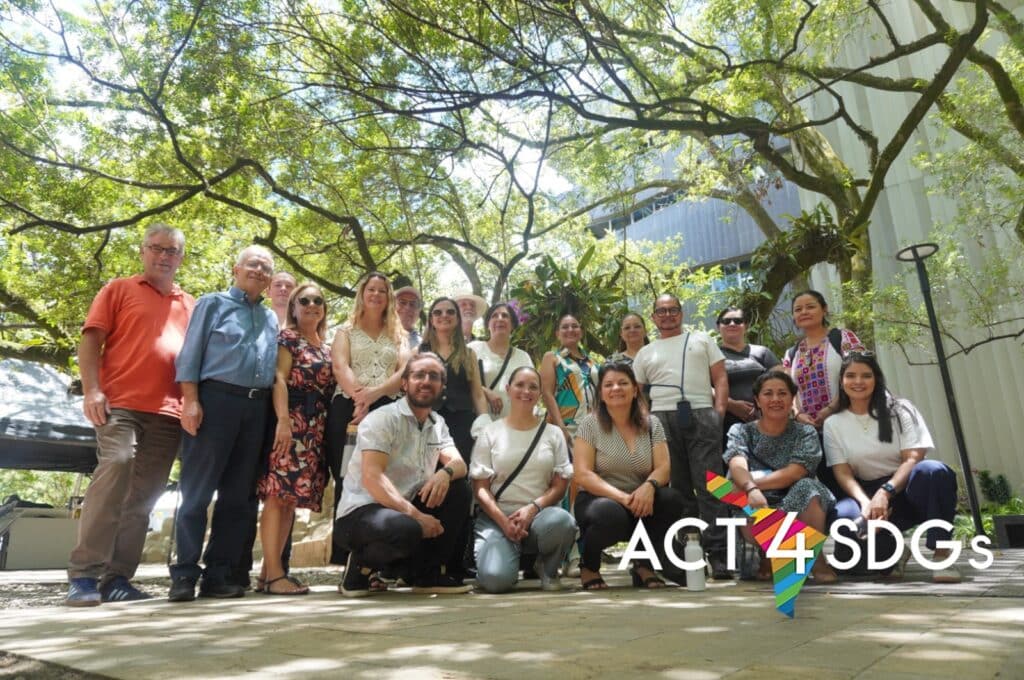
Between September 17 and 19, the final conference of the ACT4SDGs Project took place at EAFIT University campus, in Medellín, Colombia. This project has brought together10 universities from Latin America with 3 European universities, to rethink the approach to sustainability in their universities, focusing on teaching and learning.
Each of these universities has advanced environmental management and clear institutional commitments to sustainability, but these commitments have not permeated deeply into the teaching and learning areas. For this reason, this project has been innovative, starting with a diagnosis of the interest that professors show in sustainability, and their most used methodologies. Each university was able to see the potential they had to carry out a process of capacity building within the university community, a process that is enriched from an interdisciplinary perspective.
Universities created training processes on the foundations of sustainability, education for sustainable development, the SDGs, the Earth Charter and the pedagogy associated with ESD. The methodologies used in these trainings to deconstruct and build the curriculum were very appropriate to move from discursive to action. These are called DECORE+ and CARE, created by Prof. Vassilios Makrakis. Professors from various disciplines have been learning and motivating each other, to see how, from their context, they can work and promote a vision of the world associated with sustainability.
And the use of the Earth Charter as an ethical framework that complements the SDGs was reinforced, thus deepening the understanding of sustainability, not only from the technical point of view, but also making us rethink our role on this Earth, our vision of the world.
In this conference, we learned from each university, what went well or not so well, and what needs to be done. We were also inspired by the keynote lecture with Dr. Alejandro Gaviria Uribe and the youth panel, where Laura Restrepo, member of the Earth Charter International Council, participated. Especially valuable was the coexistence between the people of this consortium, with whom a beautiful community of practice has been generated, with a great desire to continue working together towards the transformation of education to better face current challenges.
Beyond the project, the hope is to share what has been learned with many more universities, since as Mateo Castillo of the Universidad Michoacana San Nicolás de Hidalgo, Mexico, mentioned during the conference, “the transformation towards sustainability is not decreed, it is built from the strengthening of capacities within universities.” From here, universities will be able to be that engine of action towards social, economic and environmental justice.
You can use the agenda to find the moments you want to hear.