

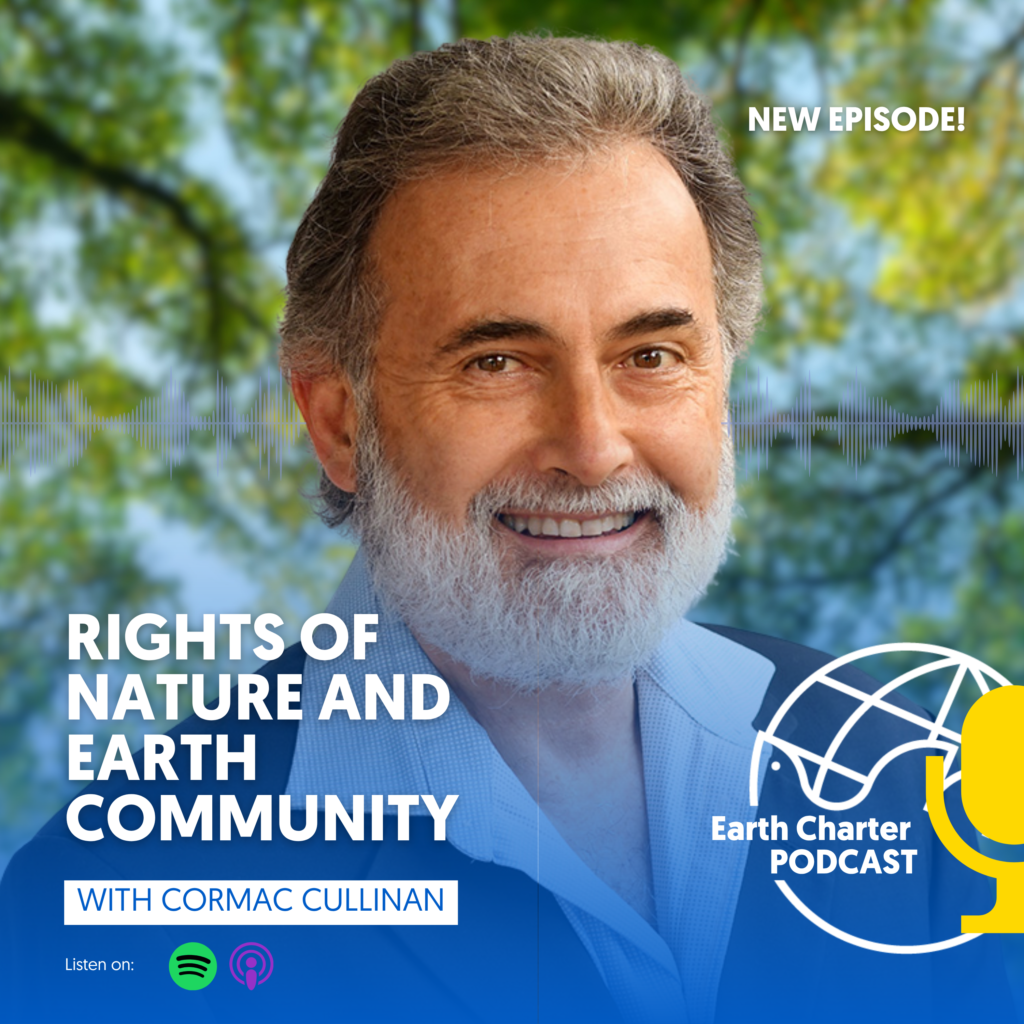
What would change if law recognized rivers, mountains, ecosystems, and the living world not simply as property or resources, but as members of a larger Earth community with rights of their own? What if the law did not see Nature simply as something we own, use, or protect, but recognized Earth as a living community with rights of its own? In this new Earth Charter Podcast conversation, Earth Charter International Executive Director Mirian Vilela speaks with South African environmental lawyer, author, and advocate Cormac Cullinan about the evolution of the Rights of Nature movement and its close relationship with the ethical vision of the Earth Charter.
Cullinan has worked for more than 25 years at the intersection of environmental law, ecological sustainability, and the rights of the natural world. He is a founder and Executive Committee member of the Global Alliance for Rights of Nature (GARN) and also the founder and managing director of the Wild Law Institute and led the drafting of the Universal Declaration of the Rights of Mother Earth, proclaimed in Cochabamba, Bolivia, in 2010.
Looking back on the Declaration’s influence, Cullinan explains that its importance lies not only in articulating rights for Mother Earth and all beings, but also in expressing corresponding human duties. It became a shared reference point for a growing international movement and helped inspire legal initiatives, advocacy, and new institutional experiments in different parts of the world.
One of those experiments is the International Rights of Nature Tribunal. Cullinan describes the Tribunal as a prototype for the kinds of institutions societies may need if human beings govern themselves as members of the Earth community. Its hearings examine alleged violations of the Universal Declaration of the Rights of Mother Earth, bringing together respected judges, legal advocates, experts, and testimony from affected communities. Rather than centering punishment, its judgments emphasize restorative justice: identifying harm, understanding its causes, and proposing what should be done to repair it.
The conversation also turns to the Table Mountain in Cape Town, South Africa. Although the mountain is legally protected as a national park, Cullinan invites a deeper shift in perception, from seeing it primarily as a recreational area to encountering it as a being with whom people are in relationship. The initiative is both legal and cultural, seeking to recover ways of relating that recognize the mountain as a living presence central to the wider community.
Antarctica offers a different and especially urgent challenge. Cullinan notes that the Antarctic region plays a vital role in regulating climate and ocean systems, yet it has no Indigenous human population or sovereign state that can speak for it in conventional international forums. The proposed Declaration for the Rights of Antarctica, that him and many others are working on, seeks to address that absence by giving the continent and surrounding ocean a voice in international affairs. He presents the initiative as a form of Earth diplomacy and as a possible step toward recognizing an ecological being within international law.
Cullinan also discusses the phrase harmonious coexistence within Nature. He says, the word “within” is deliberate: it resists the idea that humanity stands outside Nature and instead emphasizes that people live in relationship with rivers, mountains, trees, other species, and the wider Earth community. Rights of Nature, in this understanding, are not an isolated legal innovation but one means of creating the conditions for mutually enhancing relationships among all beings.
These ideas strongly resonate with the Earth Charter. Cullinan describes Earth jurisprudence and the Earth Charter as emerging from a shared intellectual and ethical tradition, including the work of Thomas Berry and an understanding of the universe as a community of subjects. He sees his work as helping to translate that vision into structures for governance: systems that recognize human beings as integral members of the Earth community and guide societies toward contributing to its health, integrity, and beauty.
For Cullinan, changing law is therefore essential to changing society. “Law is like the DNA of society,” he observes, because it distributes power, defines decision-making, and enables social patterns to reproduce themselves. If a different kind of society is needed, he argues, its legal DNA must change as well.
The episode concludes with a forward-looking call for education and collaboration. Cullinan emphasizes the importance of preparing younger generations not merely to maintain existing systems, but to transform them. He hopes that Indigenous peoples, Rights of Nature advocates, ecovillage and permaculture communities, and many others will increasingly recognize themselves as part of a wider movement of Earth-loving people. The task, he suggests, is not to create our connection with Earth, but to recognize the connection that already exists and to act from gratitude for the good fortune of belonging to this living Earth community.