

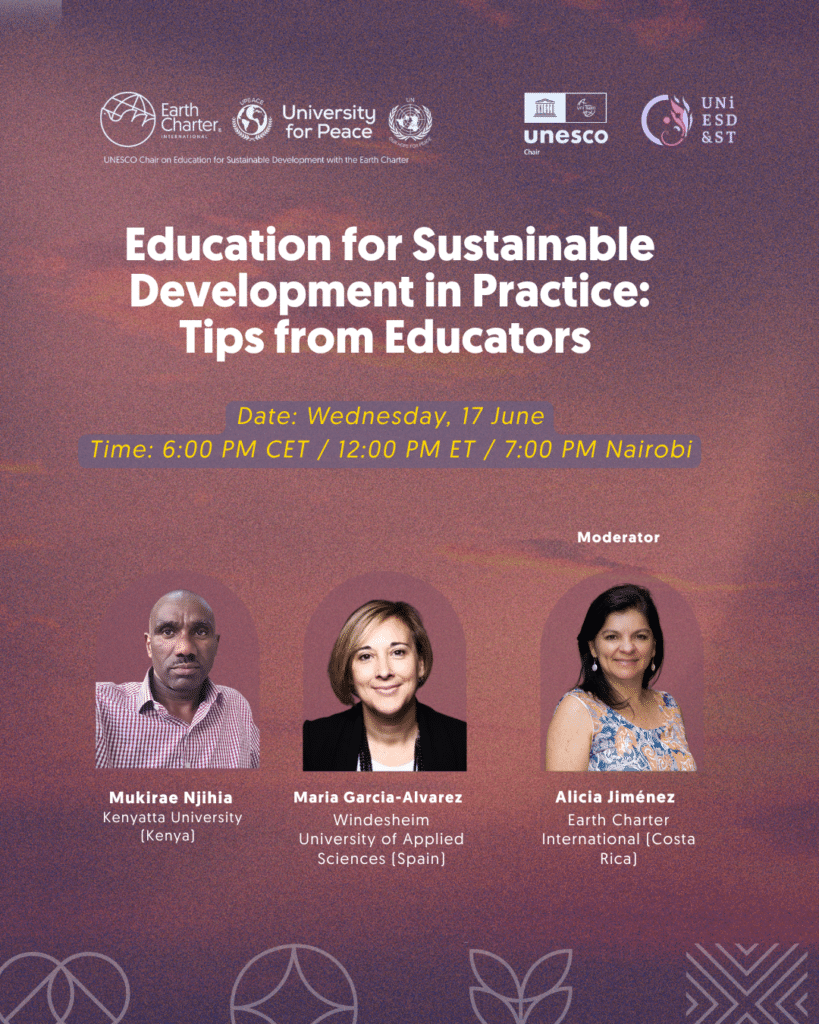
On June 17, 2026 the Webinar “Education for Sustainable Development in Practice Tips from Educators” was held online. Participants joined the webinar from around the world, including The Phillipines, Germany, Kenya, USA, Lebanon, and Puerto Rico.
This webinar was organized as a part of the UNESCO Chair on Education for Sustainable Development with the Earth Charter, which develops education programmes and research in the field of education, sustainability, as well as values and ethics.
Presenters in the webinar shared their experiences in implementing Education for Sustainable Development (ESD) and Global Citizenship Education (GCED) principles in university curriculum. The featured presenters in this webinar were:
- Mukirae Njihia, Presenter, an Earth Charter Educator who is a Lecturer, Researcher, and Consultant in the Department of Educational Management, Policy, and Curriculum Studies at Kenyatta University in Kenya.
- Maria Garcia-Alvarez, Presenter,an Earth Charter Educator who is a Senior lecturer of the Global Project and Change Management BBA program at the Windesheim University of Applied Sciences in the Netherlands.
- Alicia Jiménez, Moderator, the Director of Programmes at Earth Charter International in Costa Rica.
Maria opened with a presentation on her thesis work “Global Project and Change Management: Learning in the EduCOtone.” With her colleagues, they are trying to go beyond ESD to put in practice education as sustainability, envisioning a space she calls EduCOtone, which draws from the ecological concept “ecotone”, a space where different ecosystems meet and more diversity emerge. EduCOtone is a transdisciplinary space, with an organic curriculum that adapts according to the context, with no specific subjects, but blocks where all professors of this program collaborate. The pillars for this EduCOtone are the Earth Charter (EC, which answers the “why” for this program), the SDGs (answers the “what”) and the Inner Development Goals (refers to the “how”). There are professional and knowledge-oriented blocks in this program, to get specific skills, but there are also blocks to develop the “being”, and others that are more action oriented where students are asked to apply The Charter in projects and research that are socio-relevant and practice-oriented. The EC is integrated in the curriculum, faculty development, student engagement, research and community international network.
Mukirae shared an evaluation of the integration of ESD and GCED into curriculum at Kenyatta University in Kenya. The primary findings of this study were a need for further development of capacity building in faculty and staff members, especially in developing a multidisciplinary approach to education for sustainability, to be able to integrate these aspects in a more meaningful way. The existing curriculum is predominantly theoretical, Mukirae mentioned that pedagogical innovations are needed. He also argued that “if the students could have a more in-depth coverage of the Earth Charter and its principles, then they will be able to have a broader perspective.” He proposes achieving this through broader exposure to The Charter in compulsory courses for all students, and retooling courses to be less lecture based and more experiential.
Both presenters shared the difficulties of making widespread changes to curriculum, and provided words of encouragement to educators who wish to apply ESD and GCED in their own institutions. Educators must be willing to learn from each other and from their students, and constantly adapt their teaching style and methods to reflect the changing needs of their students as they prepare them to enter a rapidly changing world. Maria summarizes why the transdisciplinary curriculum is a necessary response to modern challenges by stating: “the message we have to give our students in this kind of moment of collapse and change, is that we are the generation also that is here living for a reason…you are here now living in this moment for a reason, because you can deal with this.”
When asked how to imbue The Charter and sustainability holistically into curriculum, Maria encouraged the utilization of The Charter as a tool to create a curriculum that is values-based and shared that many of her students see The Charter as a compass in their lives. Similarly, Mukirae encourages individual reflection and meditation on the principles of The Charter, which should then naturally lead to actions that promote sustainable practices.
A recurring theme during the webinar was the need for capacity building in educators, and its importance in education for sustainability. Sam Crowell, a faculty member of the Earth Charter Education Center for Sustainable Development, shared some of his perspective on capacity building at the conclusion of the Webinar. Sam encouraged the development of capacity building through the ownership that educators have in their curriculum, which can allow them to build some capacity, and then further develop it through a shared vision and purpose.